Principles of Security
The CIA Triad
-
Model that creates a security policy.
-
Confidentiality, Integrity and Availability have become an industry standard today.
-
If one elements of the three is not met, then the other two are useless. If a security policy does not answer these three section, then most likely it is not an effective policy.
Confidentiality
- Protection of data from unauthorized access and misuse (protect from parties that is not intended for).
Ex.: Governments using a sensitivity classification rating system (top-secret, classified, unclassified).
Intergrity
-
Information is kept accurate and consistent during storage, tramission and usage, unless authorized changes are made.
-
Steps we can take to prevent this are access control and rigorous authentication, hash verification or digital signatures.
Availability
-
Data must be available and acccesible by the user.
-
This is achieved through:
-
having reliable and well-tested software for the servers
-
having redundant technology as a backup in case of failure of the primary
-
implement well-versed security protocols to protect from attacks.
-
Questions:
- What element of the CIA triad ensures that data cannot be altered by unauthorised people?
R: Integrity
- What element of the CIA triad ensures that data is available?
R: Availability
- What element of the CIA triad ensures that data is only accessed by authorised people?
R: Confidentiality
Principles of Privileges
- Level of access to individuals is determined by:
- his role in the organisation
- the sensitivity of information stored on the system.
-
Two concepts are used to administrate the rights of individuals:
-
Privileged Identity Management (PIM) -> used to translate the user’s role within an organisation into an access role on a system.
-
Privileged Access Management (PAM) -> manages the privileges a system’s role has, enforces security policies (password management), auditing policies and reducing the attack surface a system faces.
-
Principle of least privilege -> everyone should be given the least amount of privileges such that they could do their job.
-
Questions:
- What does the acronym “PIM” stand for?
R: Privileged Identity Management
- What does the acronym “PAM” stand for?
R: Privileged Access Management
- If you wanted to manage the privileges a system access role had, what methodology would you use?
R: PAM
- If you wanted to create a system role that is based on a users role/responsibilities with an organisation, what methodology is this?
R: PIM
Security Models
The Bell-La Padula Model
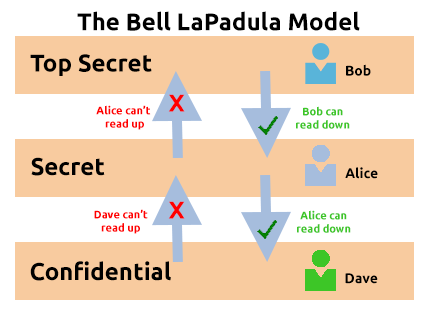
-
Used to achieve confidentiality.
-
Works by granting access to only need to know data.
-
Motto: “no write down, no read up”.
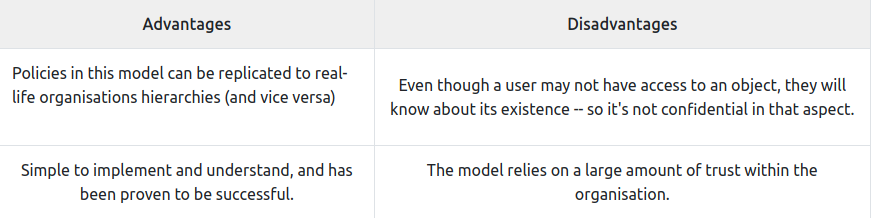
-
Popular governmental or military organisations, because their members went through vetting.
-
vetting = process that outlines the threat an applicant poses to the organisation
Biba Model
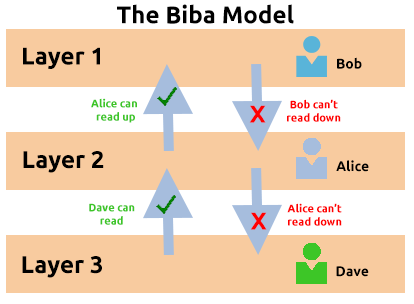
-
equivalent for Bell-La Padula but it for the integrity of CIA.
-
Motto: “no write up, no read down”
-
users can only write to objects below their level and read objects higher than their level.
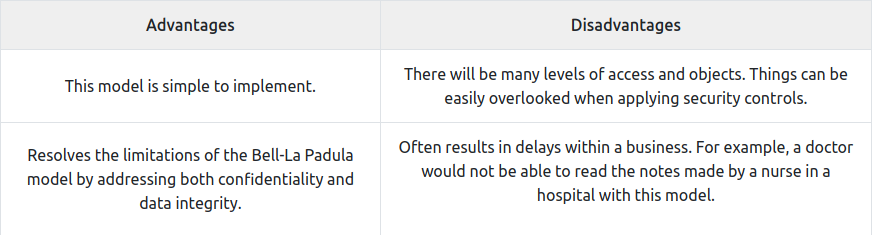
- used in org. where integrity is more important than confidentiality, for example in software develpment companies, where a developer only needs access to what is neccessary to its job, and not access to for ex, the databases.
Questions:
- What is the name of the model that uses the rule “can’t read up, can read down”?
R: The Bell-LaPadula Model
- What is the name of the model that uses the rule “can read up, can’t read down”?
R: The Biba Model
- If you were a military, what security model would you use?
R: The Bell-LaPadula Model
- If you were a software developer, what security model would the company perhaps use?
R: The Biba Model
Threat modelling & Incident Response
-
Threat modelling = review, improve and test the security protocols in an org. information infrastructure.
-
Simple threat modelling process:
Preparation -> Mitigations -> Reviews -> Identification
- A better one:
- Threat intelligence
- Asset identification
- Mitigation capabilities
- Risk assessment
- Frameworks that help with this
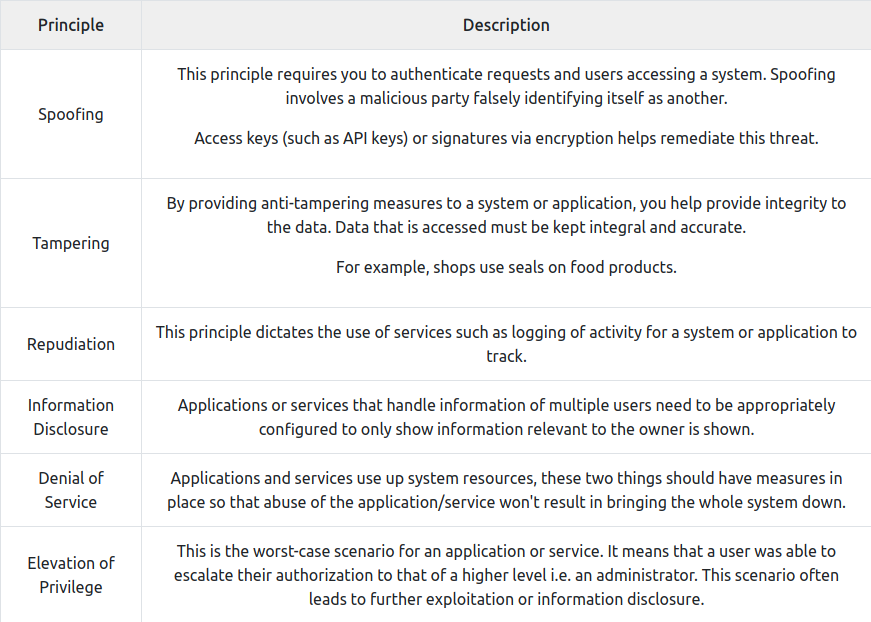
- STRIDE (Spoofing identity, Tampering with data, Repudiation threats, Information disclosure, Denial of Service and Elevation of privileges)
- PASTA (Process for Attack Simulation and Threat Analysis)
-
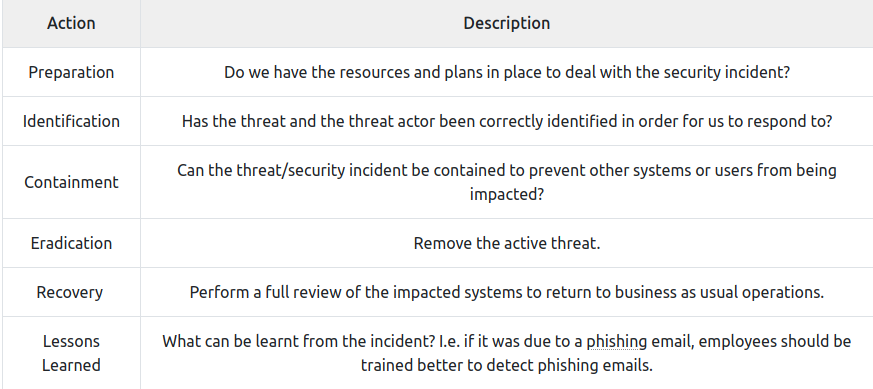
- An incident is responded to by a CSIRT team (Computer Security Incident Response Team). To solve an incident, these steps are taken:
Questions:
- What model outlines “Spoofing”?
R: STRIDE
- What does the acronym “IR” stand for?
R: Incident Response
- You are tasked with adding some measures to an application to improve the integrity of data, what STRIDE principle is this?
R: Tampering
- An attacker has penetrated your organisation’s security and stolen data. It is your task to return the organisation to business as usual. What incident response stage is this?
R: Recovery