Cryptography Basics
Importance of Cryptography
Cryptography’s ultimate purpose is to ensure secure communication in the presence of adversaries. The term secure includes confidentiality and integrity of the communicated data. Cryptography can be defined as the practice and study of techniques for secure communication and data protection where we expect the presence of adversaries and third parties. In other words, these adversaries should not be able to disclose or alter the contents of the messages.
Consider the following scenarios where you would use cryptography:
- When you log in to TryHackMe, your credentials are encrypted and sent to the server so that no one can retrieve them by snooping on your connection.
- When you connect over SSH, your SSH client and the server establish an encrypted tunnel so no one can eavesdrop on your session.
- When you conduct online banking, your browser checks the remote server’s certificate to confirm that you are communicating with your bank’s server and not an attacker’s.
- When you download a file, how do you check if it was downloaded correctly? Cryptography provides a solution through hash functions to confirm that your file is identical to the original one.
Consider the case where a company wants to handle credit card information and process related transactions. When handling credit cards, the company must follow and enforce the Payment Card Industry Data Security Standard (PCI DSS). In this case, the PCI DSS ensures a minimum level of security to store, process, and transmit data related to card credits. If you check the PCI DSS for Large Organizations, you will learn that the data should be encrypted both while being stored (at rest) and while being transmitted (in motion).
In the same way that handling payment card details requires complying with PCI DSS, handling medical records requires complying with their respective standards. Unlike credit cards, the standards for handling medical records vary from one country to another. Example laws and regulations that should be considered when handling medical records include HIPAA (Health Insurance Portability and Accountability Act) and HITECH (Health Information Technology for Economic and Clinical Health) in the USA, GDPR (General Data Protection Regulation) in the EU, DPA (Data Protection Act) in the UK. Although the list is not exhaustive, it gives an idea about the legal requirements that healthcare providers should consider depending on their country.
Questions
Q: What is the standard required for handling credit card information?
A: PCI DSS
Plaintext to Ciphertext
We begin with the plaintext that we want to encrypt. The plaintext is the readable data; it can be anything from a simple “hello”, a cat photo, credit card information, or medical health records. From a cryptography perspective, these are all “plaintext” messages waiting to be encrypted. The plaintext is passed through the encryption function along with a proper key; the encryption function returns a ciphertext. The encryption function is part of the cipher; a cipher is an algorithm to convert a plaintext into a ciphertext and vice versa.

To recover the plaintext, we must pass the ciphertext along with the proper key via the decryption function, which would give us the original plaintext. This is shown in the illustration below.

- Plaintext is the original, readable message or data before it’s encrypted. It can be a document, an image, a multimedia file, or any other binary data.
- Ciphertext is the scrambled, unreadable version of the message after encryption. Ideally, we cannot get any information about the original plaintext except its approximate size.
- Cipher is an algorithm or method to convert plaintext into ciphertext and back again. A cipher is usually developed by a mathematician.
- Key is a string of bits the cipher uses to encrypt or decrypt data. In general, the used cipher is public knowledge; however, the key must remain secret unless it is the public key in asymmetric encryption. We will visit asymmetric encryption in a later task.
- Encryption is the process of converting plaintext into ciphertext using a cipher and a key. Unlike the key, the choice of the cipher is disclosed.
- Decryption is the reverse process of encryption, converting ciphertext back into plaintext using a cipher and a key. Although the cipher would be public knowledge, recovering the plaintext without knowledge of the key should be impossible (infeasible).
Questions
Q: What do you call the encrypted plaintext?
A: ciphertext
Q: What do you call the process that returns the plaintext?
A: decryption
Historical Ciphers
Cryptography’s history is long and dates back to ancient Egypt in 1900 BCE. However, one of the simplest historical ciphers is the Caesar Cipher from the first century BCE. The idea is simple: shift each letter by a certain number to encrypt the message.
Consider the following example:
- Plaintext:
TRYHACKME - Key: 3 (Assume it is a right shift of 3.)
- Cipher: Caesar Cipher
We can easily figure out that T becomes W, R becomes U, Y becomes B, and so on. As you noticed, once we reach Z, we start all over
Consequently, we get the ciphertext of WUBKDFNPH.
To decrypt, we need the following information:
- Ciphertext:
WUBKDFNPH - Key: 3
- Cipher: Caesar Cipher
For encryption, we shift to the right by three; for decryption, we shift to the left by three and recover the original plaintext
You would come across many more historical ciphers in movies and cryptography books. Examples include:
- The Vigenère cipher from the 16th century
- The Enigma machine from World War II
- The one-time pad from the Cold War
You can experiment with Caesar cipher shifts using the interactive tool at the Cryptii website. It lets you tweak the rotation and instantly see how the text transforms.
Questions
Q: Knowing that XRPCTCRGNEI was encrypted using Caesar Cipher, what is the original plaintext?
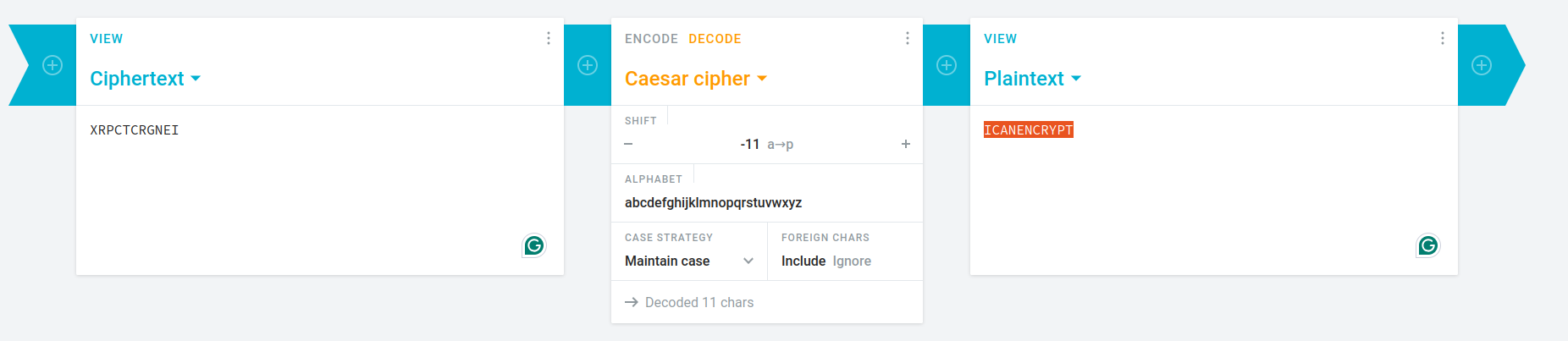
A: ICANENCRYPT
Types of Encryption
Symmetric Encryption
Symmetric encryption, also known as symmetric cryptography, uses the same key to encrypt and decrypt the data, as shown in the figure below. Keeping the key secret is a must; it is also called private key cryptography. Furthermore, communicating the key to the intended parties can be challenging as it requires a secure communication channel. Maintaining the secrecy of the key can be a significant challenge, especially if there are many recipients. The problem becomes more severe in the presence of a powerful adversary; consider the threat of industrial espionage, for instance.
Consider the simple case where you created a password-protected document to share it with your colleague. You can easily email the encrypted document to your colleague, but most likely, you cannot email them the password. The reason is that anyone with access to their mailbox would access both the password-protected document and its password. Therefore, you need to think of a different way, i.e., channel, to share the password. Unless you think of a secure, accessible channel, one solution would be to meet in person and communicate the password to them.
Examples of symmetric encryption are DES (Data Encryption Standard), 3DES (Triple DES) and AES (Advanced Encryption Standard).
- DES was adopted as a standard in 1977 and uses a 56-bit key. With the advancement in computing power, in 1999, a DES key was successfully broken in less than 24 hours, motivating the shift to 3DES.
- 3DES is DES applied three times; consequently, the key size is 168 bits, though the effective security is 112 bits. 3DES was more of an ad-hoc solution when DES was no longer considered secure. 3DES was deprecated in 2019 and should be replaced by AES; however, it may still be found in some legacy systems.
- AES was adopted as a standard in 2001. Its key size can be 128, 192, or 256 bits.
There are many more symmetric encryption ciphers used in various applications; however, they have not been adopted as standards.
Asymmetric Encryption
Unlike symmetric encryption, which uses the same key for encryption and decryption, asymmetric encryption uses a pair of keys, one to encrypt and the other to decrypt, as shown in the illustration below. To protect confidentiality, asymmetric encryption or asymmetric cryptography encrypts the data using the public key; hence, it is also called public key cryptography.
Examples are RSA, Diffie-Hellman, and Elliptic Curve cryptography (ECC). The two keys involved in the process are referred to as a public key and a private key. Data encrypted with the public key can be decrypted with the private key. Your private key needs to be kept private, hence the name.
Asymmetric encryption tends to be slower, and many asymmetric encryption ciphers use larger keys than symmetric encryption. For example, RSA uses 2048-bit, 3072-bit, and 4096-bit keys; 2048-bit is the recommended minimum key size. Diffie-Hellman also has a recommended minimum key size of 2048 bits but uses 3072-bit and 4096-bit keys for enhanced security. On the other hand, ECC can achieve equivalent security with shorter keys. For example, with a 256-bit key, ECC provides a level of security comparable to a 3072-bit RSA key.
Asymmetric encryption is based on a particular group of mathematical problems that are easy to compute in one direction but extremely difficult to reverse. In this context, extremely difficult means practically infeasible. For example, we can rely on a mathematical problem that would take a very long time, for example, millions of years, to solve using today’s technology.
Questions
Q: Should you trust DES? (Yea/Nay)
A: Nay
Q: When was AES adopted as an encryption standard?
A: 2001
Basic Math
You may be wondering how XOR can play any role in cryptography. XOR has several interesting properties that make it useful in cryptography and error detection. One key property is that applying XOR to a value with itself results in 0, and applying XOR to any value with 0 leaves it unchanged. This means A ⊕ A = 0, and A ⊕ 0 = A for any binary value A. Additionally, XOR is commutative, i.e., A ⊕ B = B ⊕ A. And it is associative, i.e., (A ⊕ B) ⊕ C = A ⊕ (B ⊕ C).
Let’s see how we can make use of the above in cryptography. We will demonstrate how XOR can be used as a basic symmetric encryption algorithm. Consider the binary values P and K, where P is the plaintext, and K is the secret key. The ciphertext is C = P ⊕ K.
Now, if we know C and K, we can recover P. We start with C ⊕ K = (P ⊕ K) ⊕ K. But we know that (P ⊕ K) ⊕ K = P ⊕ (K ⊕ K) because XOR is associative. Furthermore, we know that K ⊕ K = 0; consequently, (P ⊕ K) ⊕ K = P ⊕ (K ⊕ K) = P ⊕ 0 = P. In other words, XOR served as a simple symmetric encryption algorithm. In practice, it is more complicated as we need a secret key as long as the plaintext.
You need to work with large numbers when solving some cryptography exercises. If your calculator fails, we suggest using a programming language such as Python. Python has a built-in int type that can handle integers of arbitrary size and would automatically switch to larger types as needed. Many other programming languages have dedicated libraries for big integers. If you prefer to do your math online, consider WolframAlpha.
Let’s consider a few examples.
- 25%5 = 0 because 25 divided by 5 is 5, with a remainder of 0, i.e., 25 = 5 × 5 + 0
- 23%6 = 5 because 23 divided by 6 is 3, with a remainder of 5, i.e., 23 = 3 × 6 + 5
- 23%7 = 2 because 23 divided by 7 is 3 with a remainder of 2, i.e., 23 = 3 × 7 + 2
An important thing to remember about modulo is that it’s not reversible. If we are given the equation x%5 = 4, infinite values of x would satisfy this equation.
The modulo operation always returns a non-negative result less than the divisor. This means that for any integer a and positive integer n, the result of a%n will always be in the range 0 to n − 1.
Questions
Q: What’s 1001 ⊕ 1010?
A: 0011
Q: What’s 118613842%9091?
A: 3565
Q: What’s 60%12?
A: 0